
apprenticeships
Why investing in apprenticeships matters to the future of accountancy
Katherine Mead, head of talent development at Bishop Fleming discusses the important role that apprenticeships play in the firm.
For a long time, everyone knew how you became an accountant. School leavers went to university, and graduates joined the big firms. Apprenticeships were much less likely to be the first option suggested to school leavers.
However, that picture is changing. Almost half of the employers surveyed by First Intuition for its 2025 salary guide (47%) had increased their school and college leaver intake. As firms recruit more people through these pathways, the conversation needs to cover both the opportunity to enter the profession and the investment needed to build a career within it.
A salary, practical experience and a professional qualification without the cost of university make apprenticeships an attractive starting point. Their lasting value depends on how well firms connect study with work, support apprentices through challenges and create opportunities to progress.

Antonis Diolas
Head of Audit and Assurance with ACCA’s Policy & Insights teams, draws on extensive experience in auditing across different countries, and industries to lead on ACCA’s global work on audit and assurance. He previously served as technical advisor at the IAASB and IFAC SMP Advisory Group.

Joe Fitzsimons
Leads ACCA policy work across Europe, Eurasia, the Americas, Middle East and the UK. He was formerly a member of the policy team at the Institute of Directors, where he led across a range of policy areas, including education and skills, EDI, and SME support.
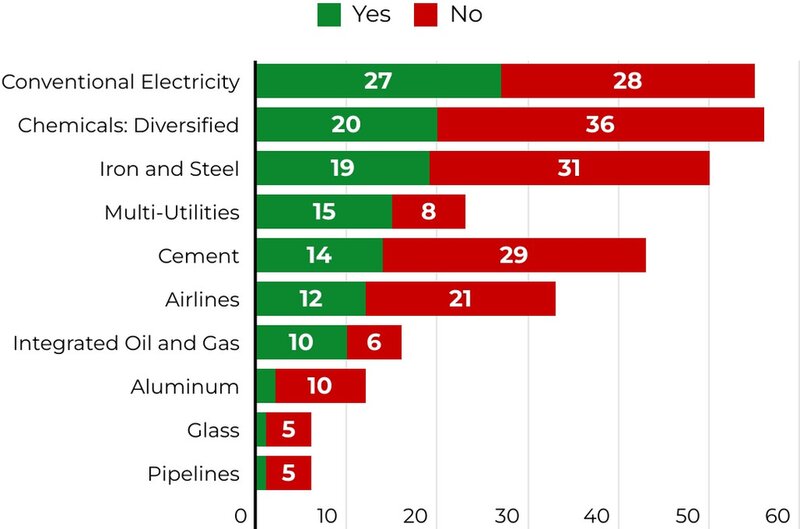
Engagement with carbon-related instruments are not concentrated in any subsectors.
Currently, there is no IFRS Accounting Standard or guidance dedicated to accounting for carbon-related instruments. Consequently, companies have had to develop their own accounting policies to account for these instruments as either assets, liabilities, income or expenses. As a result, several accounting treatments are observed across companies.
On the assets side, these instruments are most often accounted for as ‘intangible assets’, followed by ‘inventories’ and ‘financial assets’. Some companies presented these instruments as ‘other assets’. Further, these instruments are measured at cost or at fair value (or a combination of both approaches). Some companies do not disclose their measurement approach at all. On the liabilities side, some companies recognise provisions on a gross basis, while others do so on a net basis.
The size of these instruments, as a percentage of total assets or revenues, varies considerably among companies without being significant for all companies. This indicates that the instrument’s magnitude is not the sole determinant for recognition and disclosure in the financial statements. Nevertheless, there is room for improvement to provide information in the financial statements about these instruments’ nature, function, intended use, useful lives, amounts and accounting policies to help users understand their relevance and financial effects on the company.
Relatively few auditors’ reports discuss issues around carbon-related instruments. Those that do tend to discuss issues relating to the exercise of judgement or the use of assumptions, such as accounting for carbon-related instruments, measurement of these instruments, impairment tests for assets, and changes in accounting policy.

It’s about keeping employees interested in the firms they work for and retaining good talent so that they can continue to grow with, and add value to, the company. After investing in the skills to develop good people, we want to strengthen work environments that keep them.

Learning judgement alongside the syllabus
As school and college leavers become a larger part of firms’ intake, employers take on greater responsibility for their first experience of professional life. The work they are given, and the guidance that comes with it, helps shape how they develop as accountants.
Professional study provides the technical grounding. Applying it to client work involves learning to ask the right questions, explain a conclusion and recognise when further advice is needed. Those capabilities develop through practice, with experienced colleagues discussing the reasoning behind decisions rather than simply checking the answer.
Here, being an employer-provider gives us direct responsibility for connecting these parts of the apprenticeship. We can link ACA and ACA/CTA study with the work apprentices undertake, helping them understand how their learning applies to clients’ circumstances.
For firms, this means planning experience as carefully as study. Apprentices need opportunities to explain their work, receive feedback and take on more demanding work as they progress. That is how an increased intake becomes a stronger future workforce.
Responsibility needs support
Giving apprentices more responsibility also requires firms to make time for their development. A demanding piece of client work can build confidence when someone is available to discuss the approach and review the result. Without that support, it can leave an apprentice unsure whether to ask for help or to struggle on.
At Bishop Fleming, growth coaches, buddies, people development advisers, managers, specialist learning teams and external training partners contribute to that support. Clear points of contact matter: apprentices should know where to take a technical question, discuss feedback or raise difficulties balancing study with work.
The test comes when deadlines compete. Protected study time and regular conversations need to hold their place during busy periods, with managers able to recognise when someone is ready for more senior tasks and when they need more guidance.
That support begins with our Professional Foundations week, which introduces apprentices to the firm and prepares them for client work. School leavers then gain experience across Audit, Accounting and Tax before choosing a specialist area. This gives them a wider understanding of the business and helps them make an informed choice about where to build their careers.
Investing in the next generation of accountants
Removing the assumption that an accountancy career must begin with a degree allows firms to recognise potential they might otherwise overlook. Different educational paths and life experiences bring fresh perspectives, but widening recruitment only delivers lasting value when people have opportunities to progress.
At Bishop Fleming, more than a third of our workforce is made up of apprentices and trainees. Their development is central to the future of the firm. Qualification results, retention and progression help us assess that investment, alongside readiness for greater responsibility.
Firms should ask what happens after an apprentice qualifies: is there a clear next step, and have they gained the experience needed to take it? The answer depends on decisions made throughout their training, from the work they undertake to the feedback and guidance they receive.
As more apprentices enter accountancy, firms have an opportunity to broaden the profession’s talent pool and develop their future advisers and leaders. Sustained investment in those careers gives people a reason to stay and the capability to move forward.
Auditors
Auditors should:
- check the coherence of information in the financial statements and the narrative part of an annual report, and
- lend their technical expertise to support the development of globally applicable guidance for consistent accounting treatment of carbon-related instruments, and to help ensure the resulting accounting and disclosure requirements are auditable.
See here for the full report.
Main image: Aaron Saw, head of Corporate Reporting Insights – Financial, ACCA
Main video credit: fizkes / Shutterstock.com